
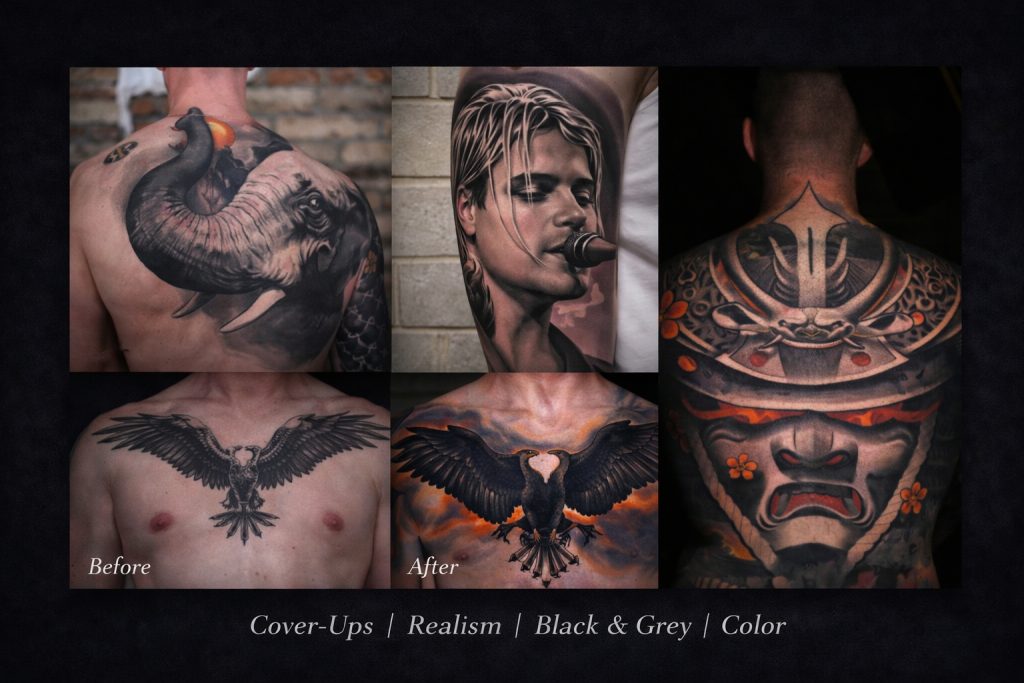
You liked it at the time. Or maybe you never really did. Either way, you are living with a tattoo that no longer feels like you — and you want to know whether anything can be done about it.
The short answer is yes. A well-executed tattoo cover up in Glasgow can completely transform ink you regret into something you are genuinely proud of. But not every studio is equipped to do this properly, and not every tattoo is handled the same way. This guide covers everything you need to know before booking your appointment.
What Is a Tattoo Cover Up?
A tattoo cover up is the process of tattooing a new design directly over an existing one. The goal is to use the new artwork to conceal, incorporate, or completely disguise the original tattoo. When done by an experienced artist, the finished piece looks like a fresh tattoo with no trace of what was underneath.
A tattoo rework, by contrast, involves improving or extending an existing tattoo without necessarily hiding it. This might mean fixing uneven lines, adding shading and depth, completing an unfinished sleeve, or refreshing faded colour. Both approaches fall under what we do at our Glasgow studio.
Can My Tattoo Be Covered Up?
This is the question we hear most often during consultations, and the honest answer depends on several things. There is no universal rule. What matters is the specific combination of factors present in your existing tattoo.
Colour and Darkness of the Original Ink
Dark, saturated tattoos are the most challenging to cover. Solid black areas in particular require a well-designed new tattoo to mask them properly — the cover design needs to be larger and darker than the original to be effective. That said, this does not make them impossible to cover. It simply means the new design needs to be planned with care.
Lighter tattoos, faded pieces, and old work that has lost saturation over the years are generally easier to work with. The less ink density beneath, the more creative freedom you have with the cover design.
Size of the Original Tattoo
A cover up design typically needs to be around 30 to 40 percent larger than the original to work effectively. This is important to understand before choosing your new design. If you come in wanting to cover a medium-sized tattoo with something small, it is not going to achieve the result you are looking for. Your artist needs to work within the constraints of what the skin and the original ink allow.
Placement on the Body
Some areas of the body allow for more design flexibility than others. A tattoo on a flat surface such as the upper arm or thigh gives the artist more room to build a cover design. Tattoos on areas with curves, joints, or limited space may require more creative planning but are rarely impossible to address.
The Condition of the Existing Tattoo
Tattoos that have been done poorly — with uneven lines, heavy scarring, or patchy saturation — sometimes need to be approached differently. In some cases, a period of laser fading before the cover up begins can help create a cleaner canvas and open up more design options. We discuss this during consultation so you can make an informed choice.
Common Reasons People Come to Us for Cover Ups in Glasgow
Every person who walks through our door has a different story, but certain situations come up again and again.
- A name tattoo that is no longer relevant. This is one of the most common reasons people seek out cover up work. Whether it is an ex-partner’s name or a design that represented something that has since changed, these tattoos are highly personal and often carry emotional weight. We treat them with complete discretion.
- Work done at a young age that no longer reflects who you are. Tastes evolve. A tattoo that made perfect sense at eighteen might feel completely out of place a decade later. That is not something to feel embarrassed about.
- Poor quality work from a previous artist. This is more common than people realise. Uneven lines, blurred edges, patchy colour, and poorly healed ink are all things we see regularly. In some cases the artist did not finish the piece at all. Stefan Max came to us with an unfinished sleeve left incomplete by his previous artist. Over several sessions, Angel rebuilt the entire piece into something that flowed naturally with Stefan’s arm and matched his original vision.
- Faded or damaged tattoos. Sun exposure, the natural ageing of skin, and the passage of time all affect how a tattoo looks. Some tattoos simply need refreshing; others benefit from a full rework that updates the design while building on what is already there.
- Impulsive decisions. Sometimes a tattoo was done without enough thought, or on a whim, and the person has regretted it almost immediately. There is no judgement here. We are here to help you move forward.
The Cover Up Process at Watcher Tattoo Glasgow
We do not take a one-size-fits-all approach to cover ups. Every tattoo is different, and every client deserves a plan that is specific to their situation. Here is how the process works when you come to us.
Step 1: Free Consultation
Everything begins with a consultation. You come in, show us what you are working with, and we have an honest conversation about what is achievable. We look at the ink density, the size and placement of the existing tattoo, your skin type, and what kind of design you have in mind. From this we can give you a clear picture of what a cover up would involve — including the realistic size and style of the new design, how many sessions it might take, and what the finished result could look like.
We do not charge for this conversation. You should never have to pay just to find out whether something is possible. Book your free consultation here.
Step 2: Design Development
Once you decide to go ahead, Angel will work on a design that both covers the existing tattoo effectively and reflects what you want. This is a collaborative process. Your input matters — the goal is to produce something you love, not just something that works technically. We take the time to get this right before any needles touch your skin.
Step 3: The Tattooing Sessions
Depending on the complexity of the cover up, the work may take one session or several. Larger pieces, heavily saturated originals, and detailed new designs all require more time. Angel does not rush sessions or cut corners to get through more bookings. Each session receives his full attention from start to finish.
Step 4: Aftercare and Follow-Up
Proper aftercare is as important as the tattooing itself, particularly for cover ups where the skin has already been through one tattooing process. We provide clear guidance on how to look after your new tattoo during the healing period, and we are available if you have any questions afterwards.
Cover Up vs. Laser Removal: Which Is Right for You?
Some people arrive unsure whether to pursue a cover up or explore laser removal. Both are valid options, and the right choice depends on what you want in the end.
| Factor | Cover Up | Laser Removal |
|---|---|---|
| Time to completion | Weeks to months (depending on sessions) | Months to over a year |
| End result | New tattoo in place of the old one | Reduced or removed ink — blank skin |
| Cost | Single investment | Ongoing sessions can add up |
| Pain level | Similar to standard tattooing | Often described as more uncomfortable |
| Best for | Those who want new artwork | Those who want clean skin |
In some situations, a combination of both works best. A few laser sessions to fade the original ink can open up cover up options that would not otherwise be available. We are happy to discuss this as part of your consultation.
What Makes a Good Cover Up Artist?
Not every tattoo artist is experienced with cover up work. It requires a specific set of skills that go beyond general tattooing ability.
A cover up artist needs to understand how existing ink interacts with new pigment — which colours will blend, which will compete, and which combinations will create muddy results. They need to be able to work with constraints that a blank-canvas tattoo does not have. They need to understand light, shadow, and density well enough to effectively mask what is underneath while producing something that looks intentional and clean.
Angel Mitov has been doing this work for over fifteen years. He has won multiple awards for his realism work, but his understanding of how ink behaves in skin is what makes his cover ups consistently successful. He is also direct with clients about what is and is not achievable — because a cover up that fails to actually cover the original is worse than no cover up at all.
“Angel carefully researched the work that was already there and rebuilt it over several sessions. The piece was reconstructed into a full sleeve that flowed naturally with his body and vision.” — Stefan Max, Glasgow
Styles That Work Well for Cover Ups
Some tattoo styles are particularly effective for cover up work because of the way they use density, shadow, and bold elements.
Black and Grey Realism
One of the most versatile cover up styles. Deep shadows and rich black tones can absorb and mask existing ink effectively. The level of detail achievable in black and grey realism also allows the artist to build complexity that draws the eye away from anything underneath.
Colour Realism
Colour realism can be highly effective for cover ups, particularly when strategic use of darker tones is built into the design. Flowers, animals, and nature-based imagery are popular choices because they naturally incorporate a mix of light and shadow that works well over existing tattoos.
Neo-Traditional and Bold Designs
Strong outlines and areas of solid colour make these styles well-suited to covering heavier original tattoos. The boldness of the design naturally dominates the visual space, making it easier for the eye to read the new artwork rather than anything beneath it.
Geometric and Abstract Work
Depending on the original tattoo, geometric designs can be used creatively to incorporate rather than simply conceal existing elements. This approach works particularly well when the original tattoo has clean lines that can be folded into the new composition.
Frequently Asked Questions About Tattoo Cover Ups in Glasgow
How much does a tattoo cover up cost in Glasgow?Cover up pricing depends on the size, complexity, and number of sessions required. Because cover up work involves additional planning and skill compared to a fresh tattoo, it is often priced accordingly. We provide a clear quote after your free consultation so there are no surprises.
Will the original tattoo show through at all?When a cover up is designed and executed properly, no. The new tattoo should completely conceal the original. If there is any risk of the old ink showing through, we will tell you during the consultation stage so you can make an informed decision about whether to proceed or consider laser fading first.
Does a cover up hurt more than a regular tattoo?The sensation is broadly similar to standard tattooing. Some clients report that previously tattooed skin can feel slightly different, but there is no consistent evidence that cover up work is significantly more painful than getting a tattoo on fresh skin.
How long does a cover up take to heal?Healing times are similar to a standard tattoo — typically two to four weeks for the surface to heal, with deeper layers of skin taking up to three months to fully settle. We will walk you through the aftercare process in detail after your session.
Can I get a cover up on a tattoo I only got recently?It is generally advisable to wait until a tattoo is fully healed before covering it — usually a minimum of three months. If your tattoo is still fresh, come in for a consultation and we can advise on timing.
Do you offer consultations before committing to the cover up?Yes. Every cover up at Watcher Tattoo begins with a free consultation. This is not optional — it is essential. A proper assessment of your existing tattoo is the only way to give you an honest picture of what is achievable.
Why Choose Watcher Tattoo for Your Cover Up in Glasgow?
There are plenty of tattoo studios in Glasgow. The reason clients travel from across Scotland to work with us — and the reason many of them have been coming back for years — comes down to a few things that we refuse to compromise on.
Angel does not take on cover up work he cannot deliver. If a design is not going to work, he will say so at the consultation stage, even if that means suggesting a different approach. This level of honesty is not universal in the industry, and it matters when you are making a permanent decision about your body.
The quality of the work speaks for itself in our gallery. Every cover up and rework in there represents a client who came in with a problem and left with something they are proud to show off. That is the standard we hold ourselves to, and it does not change based on the size of the piece or the complexity of the challenge.
If you are ready to stop hiding a tattoo you regret, or simply want to know what your options are, the first step is simple. Book a free consultation. There is no pressure, no commitment, and no charge.
Ready to Transform Your Tattoo?
Book a free consultation at Watcher Tattoo Glasgow and find out exactly what is possible. No pressure, no commitment — just honest advice from an award-winning realism artist.
Final Thoughts
A tattoo cover up is one of the most significant decisions you can make about your body art. Done well, it gives you the freedom to move forward — to wear your skin without the weight of something that no longer belongs there. Done poorly, it creates a different set of problems.
The key is choosing an artist who understands the specific demands of cover up work: one who will be honest with you about what is possible, who will invest proper time into the design, and who has the technical skill to execute it at a high level.
If you are in Glasgow, or are willing to travel for work you will genuinely be proud of, we would be glad to hear from you. The consultation is free. The conversation starts whenever you are ready.