
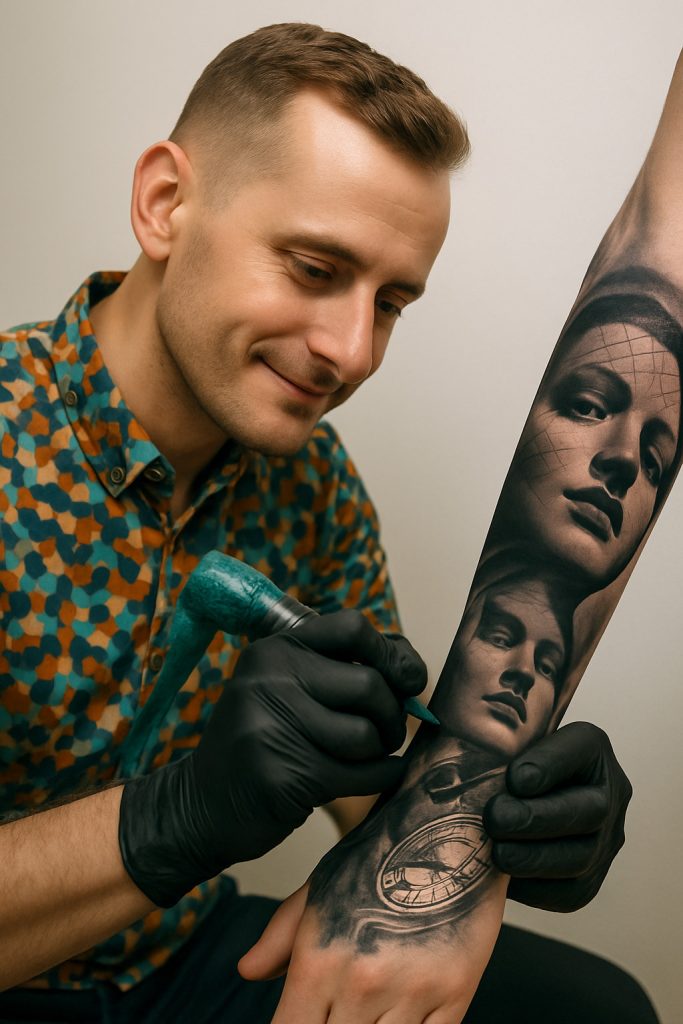
Getting a tattoo is one of the most personal decisions you will ever make. The result stays with you for life — so choosing the right tattoo artist in Glasgow is not something to rush, compare purely on price, or leave to chance. This guide walks you through everything that genuinely matters, from reading a portfolio correctly to understanding the consultation process, so you can book with confidence.
Why Choosing the Right Tattoo Artist Matters More Than You Think
Many people book a tattoo based on convenience — the nearest studio, a flash sale, or a friend’s recommendation for a completely different style. The problem is that tattooing is a permanent art form, and not every artist excels at every style.
A portrait tattoo demands a deep understanding of light, shadow, and how ink sits in skin. A geometric piece requires mathematical precision. What looks sharp in a fresh photograph can fade, blur, or distort badly within years if the technique was wrong. That is why matching the right artist to your idea is the single most important decision in the whole process.
Start With the Portfolio: It Tells You Everything
A portfolio is the most honest signal you have. Before you read reviews or visit the studio, spend time studying the work. Here is what to look for:
Look for Consistency, Not Just Highlights
Any artist can post their ten best pieces. What matters is whether quality is consistent across dozens of images. Inconsistency in a gallery usually means inconsistency on your skin.
Match the Portfolio to Your Style
If you want a colour realism tattoo, do not book an artist whose portfolio is full of traditional flash designs. These require entirely different skill sets. Always look for repeated, confident examples of exactly the style you want.
Ask for Healed Work
Fresh tattoos always look sharp. The real test is how a tattoo looks after healing. Ask if the artist has healed examples — this is what separates genuinely skilled artists from those who rely on editing and fresh-ink photography.
Check for Technical Precision
Look closely at line consistency, smooth shading gradients, and even colour saturation. Poor linework and patchy shading are warning signs, regardless of how appealing the overall design looks. You can see real examples of technical precision in the Watcher Tattoo gallery.
Understand What Specialism Means in Tattooing
The best artists tend to specialise, and that focus is what elevates their work above a generalist. Here are the key styles to understand when searching for the best tattoo artist in Glasgow:
- Realism and Colour Realism — Requires deep understanding of depth, dimension, and skin tone. See Angel’s award-winning colour realism work for what this looks like at the highest level.
- Black and Grey — Relies entirely on tonal variation with no colour to mask mistakes. Requires absolute control of shading. Explore Watcher Tattoo’s black and grey specialism.
- Portrait Tattoos — Faces are unforgiving — even a small proportion error changes the likeness completely. Read more about our portrait tattoo service.
- Cover-Up and Rework — Requires artistic skill plus creative problem-solving around existing ink. See how we approach cover-up and rework sessions.
- Traditional and Neo-Traditional — Bold lines and flat colour that must be executed cleanly to age well.
When you know which style suits your idea, you can immediately narrow your search to artists with genuine depth in that area.
Research the Artist’s Background and Experience
Experience alone does not guarantee quality, but it is an important filter. Here is how to research properly:
Years in the Industry
Tattooing has a steep learning curve. An artist with a decade or more of consistent practice has navigated thousands of variables across hundreds of clients — different skin types, placements, and healing processes. That experience builds intuition you cannot fake.
Awards and Recognition
Winning at recognised tattoo conventions is an external validation of skill that goes beyond reviews. Angel Mitov won multiple awards at the Bulgarian Tattoo Convention across several years — peer recognition in a competitive environment. You can read the full story on the About Angel page.
The Journey Behind the Artist
Angel began tattooing at fifteen, building his first machine from spare radio parts and practising on fruit before touching real skin. That early discipline — learning control, depth, and patience before anything else — shapes the precision that defines his work today.
Ongoing Development
The best artists never stop learning. Look for new techniques in recent work, convention attendance, or styles that continue to evolve. Stagnation in a portfolio is a subtle warning sign.
Read Reviews With a Critical Eye
Reviews are useful, but they require interpretation. Here is how to read them properly:
- Look for specific detail. Reviews describing the consultation process, how the artist listened, and how the healed result looks are far more valuable than generic five-star praise.
- Check for repeat clients. People who return for multiple sessions, or refer friends, are the strongest endorsement. Kai Vaughn, for example, said he would not go to anyone else — and recommended Angel to friends who felt the same.
- Notice how the studio handles criticism. A professional studio that responds to feedback calmly demonstrates the same approach it will bring to your session.
- Cross-reference platforms. A strong reputation is consistent across Google, social media, and direct testimonials.
The Consultation: The Most Important Step Before You Book
A professional tattoo artist will always offer a consultation before you commit. This is not a sales meeting — it is a critical conversation where both parties decide if they are the right fit. Here is what a good consultation looks like:
The Artist Listens First
A quality artist spends the majority of the consultation asking questions. They should want to know what the tattoo means to you, your lifestyle, your pain tolerance, placement preferences, and aesthetic goals.
Honest Feedback
The best artists will tell you if your idea needs adjustment — for technical, placement, longevity, or compositional reasons. If an artist agrees with everything without pushback, that is a warning sign, not a comfort.
Clear Process Explained
You should leave knowing what to expect: number of sessions, healing time, aftercare requirements, and realistic cost. Vagueness at the consultation stage leads to disappointment later.
No Pressure
Shanley Smith described her experience at Watcher Tattoo as having no rush or pressure — she met first to go over ideas, trialled a couple of designs, and sat with the decision before committing. That is what a trustworthy consultation feels like.
Ready to talk through your idea with no obligation?
Hygiene, Safety, and Studio Standards
No matter how exceptional the artistry, hygiene is non-negotiable. A reputable studio will meet all of these standards without exception:
- Single-use needles opened in front of you
- Autoclave sterilisation for all reusable equipment
- Disposable gloves changed regularly throughout the session
- Clean, organised workspace with no cross-contamination risk
- Written and verbal aftercare guidance provided after every session
Feel free to ask about hygiene practices before your session. A professional artist will answer clearly and without defensiveness.
Price: What It Actually Tells You
Tattooing is one of those industries where choosing the cheapest option almost always costs more in the long run. Laser removal, cover-up work, or rework by a skilled artist to fix a poor tattoo will always cost significantly more than paying for quality the first time.
- Hourly rate vs flat rate. Most experienced artists charge by the hour for complex work. A higher hourly rate from a specialist is almost always better value than a lower rate from a generalist.
- Complexity and size. Realistic portraits, full sleeves, and detailed colour work require more time and skill. Expect pricing to reflect that. See our services page for what is involved in each style.
- What is included. Does the price include the consultation, custom design, and revisions? At Watcher Tattoo, your idea is always the starting point — not an afterthought.
- Avoid unusually low quotes. If a quote is significantly below market rate for the complexity of your work, ask why. Experienced artists in Glasgow do not need to undercharge.
Questions to Ask Before You Commit
Before booking any tattoo artist in Glasgow, use these questions during your consultation. A confident, experienced artist welcomes every single one. Hesitation or vague answers are information in themselves.
1. Can I see examples of this exact style in your portfolio?
Always ask this before anything else. A skilled artist will have multiple consistent examples of your chosen style — not just one or two standout pieces. If the portfolio lacks examples that match your idea, that artist is not the right fit, regardless of how talented they are in other styles.
2. Do you have healed examples I can look at?
Fresh tattoos always look sharp. What matters is how the work holds up after healing. Healed examples reveal the true quality of an artist’s technique — line stability, colour retention, and shading depth. Always ask to see them before committing.
3. Have you done this type of placement before?
Placement affects everything — how the tattoo wraps around the body, how it ages, and how painful the session will be. Certain areas like ribs, hands, and necks require specific experience. An artist who has worked that placement before will give you an honest, informed answer.
4. What happens if I want to change the design before we start?
Your comfort with the design matters more than saving time. A professional artist will build in a revision process and never rush you into approving something you are unsure about. At Watcher Tattoo Glasgow, the design process starts with your idea and is refined until you are completely happy.
5. How many sessions do you estimate this will take?
Larger, more detailed pieces — such as portrait tattoos or full sleeves — are completed across multiple sessions. An experienced artist will give you a realistic estimate upfront so you can plan your time and budget accordingly. Be cautious of anyone who underestimates sessions just to secure a booking.
6. What aftercare do you recommend?
Aftercare directly affects how your tattoo heals and how long it lasts. A thorough artist will explain the full healing process — what to apply, what to avoid, and what to watch out for. If aftercare advice is vague or rushed, that tells you something about how much care goes into the overall experience.
7. How do you handle touch-ups if something heals unevenly?
Skin is unpredictable. Even the best tattoos occasionally need a small touch-up after healing. Ask upfront whether touch-ups are included, what the process looks like, and how long after the session they can be done. A studio that stands behind its work will have a clear, fair answer.
8. What are your sterilisation procedures?
This is non-negotiable. Single-use needles, autoclave sterilisation for reusable equipment, fresh gloves, and a clean workspace are baseline requirements — not extras. A professional artist will answer this question without hesitation and may even show you the setup before you begin.
Why Clients Across Scotland Choose Watcher Tattoo Glasgow
Angel Mitov founded Watcher Tattoo on a clear principle: your idea always comes first. That client-led approach — listening before designing, designing before booking, never rushing a session — is why clients travel from across Scotland to work with him.
Whether you are considering a detailed portrait, a full colour sleeve, a cover-up that finally corrects a past mistake, or a black and grey piece built on pure technique, Watcher Tattoo brings award-winning skill and genuine care to every session.
Take the first step — no pressure, no rush. Just an honest conversation about your idea.
Final Thoughts
Choosing the best tattoo artist in Glasgow comes down to matching skill to your vision, taking the consultation seriously, and not compromising quality to save money short-term. A tattoo made with care by the right artist is something you will be proud of for the rest of your life.
Do the research, ask the right questions, and trust the process. When you find the right artist — you will know.